-15% on all HARNESSES | Delivery time up to 7 business days 🪡🚀
Neapolitan Mastiff – a descendant of the first Molossians
Neapolitan Mastiff – a descendant of the first Molossians
Date: August 7, 2024 (Updated: November 25, 2024) Category: Blog, Dog breeds,
The Neapolitan Mastiff is a unique friend that impresses with its strength, loyalty and majestic appearance. He is a representative of an impressive breed with a rich history. It comes from Italy, where it was originally used as a guard and fighting dog. Currently, it attracts the attention of pet lovers around the world and boasts a wide group of loyal fans.
The Neapolitan Mastiff (mastino napoletano) is a direct descendant of the first Molossians, i.e. Tibetan mastiffs, which were bred by the ancient peoples of Mesopotamia. They were distinguished by great courage and bravery and were used to fight large, wild animals, as well as to protect domestic animals and guard farms. They were probably brought to the Mediterranean by Phoenician merchants. The ancient Romans, impressed by these dogs, gave them a Latin name - canis pugnax, meaning fighting dog. In the heyday of the Roman Empire, descendants of the Neapolitan mastiff were used during legionary military expeditions, to fight in arenas with gladiators, bears, lions and tigers. During the period when the Spanish tried to conquer southern Italy, mastiffs from the Naples area were crossed with other dog breeds from the Iberian Peninsula.
During World War I, Neapolitan Mastiff breeding was in crisis. It was only at the end of the 1949s that planned breeding was returned, aimed at creating a breed whose impressive dimensions attract attention and whose overall appearance makes a great impression. Moreover, an intelligent dog was bred, a vigilant guard, devoted and full of dignity. To develop the first official Neapolitan Mastiff breed standard, dogs named Guaglione and Pacciana were used, which were entered into the Italian pedigree book. In 1956, the Mastino Napoletano Association was founded, and the Neapolitan Mastiff breed was officially recognized by the FCI in 2. According to the FCI classification, the Neapolitan Mastiff belongs to group 2.1 - pinschers, Molossian schnauzers and Swiss cattle dogs, section XNUMX - mastiff-type molosses.
Appearance of the Neapolitan Mastiff
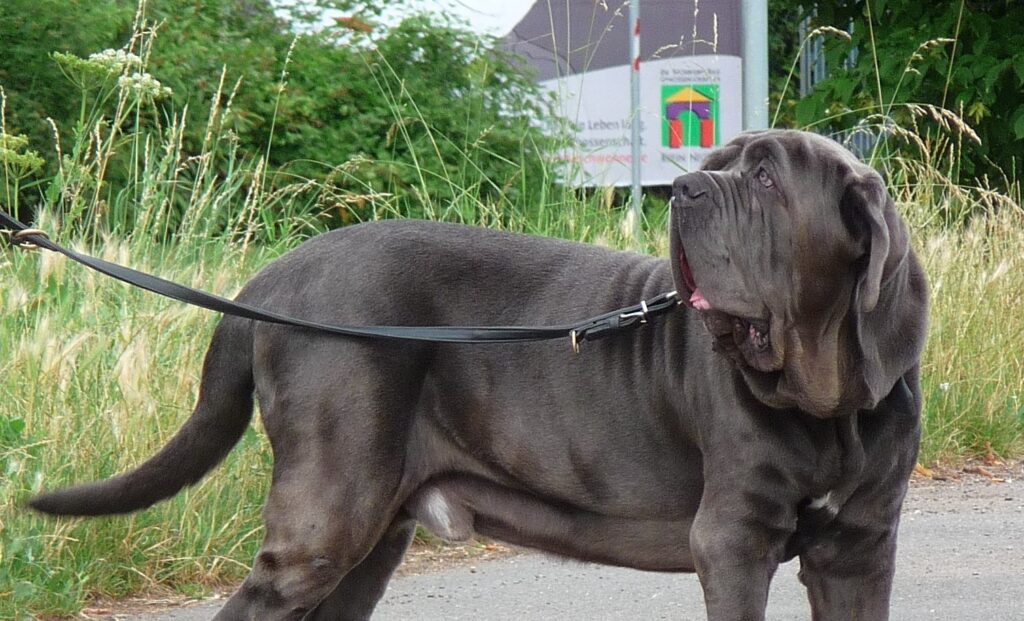
The Neapolitan Mastiff is a large, muscular dog with a massive body. Adult males weigh from 60 to 70 kg, and females 50 - 60 kg and, respectively, 65 - 75 cm and 60 - 68 cm in height at the withers. Its head is exceptionally wide with abundant wrinkles, giving it a menacing yet majestic appearance. It has a large nose with wide open nostrils - black in dogs with dark fur, dark gray in dogs with other colors or brown in red fur. Strong jaws, abundant lips, very long and clearly drooping. The eyes are set wide apart and are usually dark in color, similar to the color of the fur. The ears, relatively small compared to the size of the dog, are triangular in shape, flat and drooping. The neck is short and muscular, and the body is wide and strong. The Neapolitan Mastiff's tail is thick at the base and strong, tapering towards the end. The legs are strong, well muscled, proportional to the size of the dog.
A characteristic feature of the Neapolitan Mastiff's structure is thick, abundant and loose skin all over its body, with numerous wrinkles and folds. The dog has no undercoat, and the hair is short, dense and of the same length - up to 1,5 cm at most. The color may be brindle in the following colors: gray, lead, black, brown or fawn. Sometimes there are small white markings on the chest and fingertips. The shade of blue of the Neapolitan Mastiff is not recognized in the breed standard. The Neapolitan Mastiff is also distinguished by its way of moving. In the breed standard, it is referred to as a "cat gait" because when the dog trots, it pushes strongly with its hindquarters and rarely gallops.
Young Neapolitan Mastiff
Character
The Neapolitan Mastiff is an intelligent dog with a unique character that makes it an ideal companion and guardian. He is extremely loyal, affectionate and friendly. He has a calm and balanced disposition, rarely barks without reason, spends a lot of time napping and loves to lounge around. He quickly establishes close relationships with household members. He is affectionate towards all family members, but usually chooses the person to whom he is most attached and to whom he shows devotion at every step. Despite its majestic stature, it is gentle towards children, but the condition for a safe relationship with children is proper socialization of the pet from a young age and adult supervision during their joint games. It is also important that children are taught to respect the dog, not to irritate it and treat it with attention.
In addition to devotion, this breed is known for its protective instinct. The Neapolitan Mastiff is fearless and ready to defend its territory and loved ones against any threat. While walking, he pays no attention to passers-by, giving the impression of being uninterested in his surroundings, but he controls everything. He appears to be lethargic, but when alerted and provoked, he can be fast and violent. It usually does not react to minor taunts from other dogs, but when attacked it may show its more dangerous side. Thanks to proper socialization, the mastiff can accept other animals in its environment. However, introducing a mastiff into a home with other animals should be done in a controlled manner, by gradually building positive relationships.
Neapolitan Mastiff care requirements
Like all giant breeds, the Neapolitan Mastiff is more susceptible to orthopedic problems. This mainly concerns: dysplasia of the hip joints, less often of the elbow joints. As a result of productive changes, the joint has a limited range of motion and the limb becomes stiff and the dog limits its use. The less active pet then gains weight, further worsening the situation. In addition to conservative treatment, you should take care to supplement joint support products such as: glucosamine, chondroitin, omega-3 fatty acids, collagen, sodium hyaluronate. In addition, it is important to provide proper nutrition, control the pet's weight, and ensure an optimal level of physical activity. Following a healthy diet is an equally important aspect in the context of digestive system problems typical of this breed.
Neapolitan Mastiff care is not particularly complicated. Despite its short hair, the dog should be brushed at least once a week and bathed every few months. Particular attention should be paid to skin folds, which must be cleaned regularly and dried thoroughly to prevent infections.
The mastiff's claws should be trimmed every few weeks, and its ears should be regularly checked and cleaned with a gentle cleaning agent. Eye hygiene is equally important, it is worth checking regularly and wiping the eye area with a damp cloth. To ensure a healthy and happy life, regular visits to the vet, following his recommendations and vaccinations are also crucial.
Health and common health problems of Neapolitan Mastiffs
The Neapolitan Mastiff is prone to various diseases that may affect its quality of life. Understanding these issues is crucial for the owner to be able to provide their four-legged friend with appropriate care, both at home and at the vet.
Dysplasia of the hip and elbow joints. It is a genetic deformation of the joints that can lead to painful arthrosis and difficulty in moving. Conservative treatment is used (painkillers and anti-inflammatory drugs), and in more serious cases - surgery. The therapy is supported by a carefully selected diet, weight control and adjustment of the level of physical activity.
Gastric volvulus (GDV), also known as gastric dilatation-flatulence. The abdomen becomes swollen and tense, there is excessive salivation, weakness, difficulty breathing, and pale gums. This is a life-threatening condition that requires immediate veterinary intervention and surgery.
Skin problems. Due to their abundant, loose skin, Neapolitan Mastiffs are susceptible to a variety of skin problems, including infections, fungal infections and irritations. In addition to appropriate daily care, pharmacological treatment (antibiotics, corticosteroids, antifungal, anti-inflammatory or antihistamine drugs) and local treatment (medicated shampoos, ointments and creams) are used.
Heart disease, especially dilated cardiomyopathy. This is a condition in which the heart becomes enlarged and does not pump blood effectively. The disease requires constant veterinary supervision and treatment tailored to the individual needs of the dog. The most common symptoms are weakness, difficulty breathing, coughing, fainting and weight loss.
Eye problems, including entropion (a condition in which the eyelids roll inward) and ectropion (a condition in which the eyelids roll outward). Both of these diseases can cause eye irritation and infection, requiring surgical intervention. Treatment involves surgical correction of the eyelid.
Once again, it is worth emphasizing that regular visits to the vet, enabling early detection and treatment of health problems, can significantly improve the quality and length of life of these majestic dogs.
Adult Neapolitan Mastiff on a walk
Neapolitan Mastiff training tips
The Neapolitan Mastiff does well in a calm, balanced home where it can feel safe and loved. He likes to accompany household members during their daily activities, and his protective instinct makes him feel responsible for the safety of his loved ones.
However, it is worth remembering that the Neapolitan Mastiff needs proper upbringing and training. Its size and strength make it require consistent and patient care. He must be able to understand the dog's needs and teach him appropriate behavior. Regular exercise and mental stimulation are also important to keep your pet in good physical and mental condition. Early socialization is key in education, including introducing a four-legged friend to various environments, people and animals, defining clear and consistent rules and positive reinforcement. It is worth starting the training by learning the key commands for safety and control, such as "sit", "stay", "come to me" and "let go". Additionally, keep in mind that the Neapolitan Mastiff needs both physical and mental stimulation. Regular exercises and intellectual games help keep your four-legged student in good shape and prevent boredom.
Summary
Thanks to its unique character traits, the Neapolitan Mastiff can become a wonderful, faithful friend and an excellent guard. He provides security and unconditional love to his family. Its impressive, majestic stature and abundant wrinkles give it a menacing appearance, but in fact it is a dog with a calm and balanced character. His gentleness and patience make him a suitable companion for both single people and families with children. However, it requires consistent training based on positive reinforcement, as well as regular veterinary care to prevent common health problems of this breed.
The decision to adopt a Neapolitan Mastiff into your family should be well thought out. If you are willing to devote time to training and caring for it and provide it with love and appropriate conditions, this pet will certainly reward you with loyalty, affection and devotion.
Most frequently asked questions
Where does the Neapolitan Mastiff breed come from?
The Neapolitan Mastiff comes from Italy and is a descendant of Tibetan Molossians that were bred by the ancient peoples of Mesopotamia. They were probably brought to the Mediterranean by Phoenician merchants.
What does the Neapolitan Mastiff look like?
The Neapolitan Mastiff is a large, muscular dog with a massive body and a large head with abundant wrinkles. Adult males weigh from 60 to 70 kg, and females weigh from 50 to 60 kg. They reach a height at the withers of 60 to 75 cm.
Is the Neapolitan Mastiff suitable for apartments?
Due to its size and need for space, the Neapolitan Mastiff feels better in a house with a large garden. He may feel restricted in his apartment unless he is provided with adequate amounts of physical activity.
CDoes the Neapolitan Mastiff get along well with children?
Yes, the Neapolitan Mastiff is gentle and patient with children, but requires proper socialization and adult supervision when playing together. Children should be taught to respect dogs.
How long does a Neapolitan Mastiff live?
The average lifespan of a Neapolitan Mastiff is 8 to 10 years. Regular veterinary care, proper nutrition and weight control can significantly impact the quality and length of his life.
Bananas are a rich source of vitamins, minerals and other nutrients with health-promoting properties. These fruits also improve well-being and add energy. Since bananas have such a beneficial effect on the human body, many dog owners wonder whether they can have an equally beneficial effect on the health of their four-legged friend. The answer is the same as with any new fruit introduced to your pet's menu. When including bananas in your dog's diet, be careful and follow all feeding guidelines.
A dog's eyes, just like a human's, provide about 70% of the information from the environment. They are highly vascularized and innervated, making them highly susceptible to irritation, allergies, injuries and other diseases. They are affected by many external factors every day, which is why they require special protection and care. Red eyes in a dog should be seen as a symptom of a disease that may have various causes. Therefore, it is crucial to recognize the causes of the disease and quickly apply the appropriate treatment.
The Bullmastiff is one of the most alert and caring dogs. The impressive silhouette of this strong and muscular dog conceals a loving and good-natured four-legged companion who delights with its calmness and is famous for its strong attachment to its loved ones.