Retrieval accessories
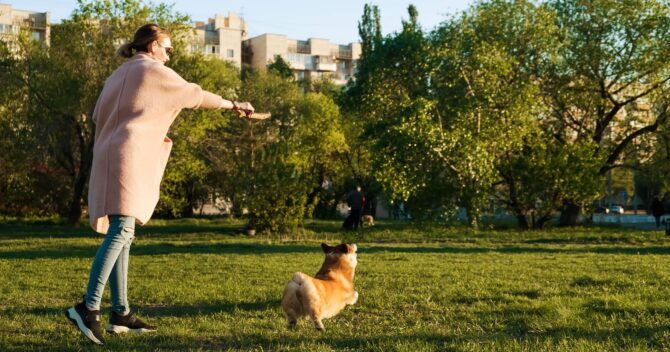
Before you start learning how to retrieve, it is worth considering what kind of toys our pet prefers. The apport should also be adjusted to the size of the dog's jaws. The correct selection of retrieving accessories will greatly facilitate subsequent training. For retrieving, we can use all kinds of balls, fabric cords, frisbee, latex sticks, squeaking figures, ringos, dumbbells. Small, lightweight, flexible items that can be thrown a long distance work well. Toys with a special surface that make it easier to grasp the object and are a great solution bright, vivid colors encouraging to play, additionally making it easier to find the toy when lost. When selecting you should also make sure that all accessories are safe for your pet, made of durable and flexible material that does not injure the gums. As some dogs are reluctant to apportion, it is a good idea to stock up on two items so that you can swap one for another if necessary. Of course, you can also use ordinary sticks.
Science for Dummies
There is a group of dogs that have fetching in their blood. However, how to deal with a pet that is not interested in this type of activity. First of all, after selecting the appropriate file, we must teach the dog to hold the object in its mouth. Put it on the ground and reward your pet for reacting to the item. We praise each sniff or catch in the teeth with words and reward. If your pet is still not interested in retrieving it, you can spread it with something encouraging or tasty. We can also make the dog run away with the object. We must take into account that this stage may require a lot of creativity and a large dose of energy. If the dog finally picks up the Aport from the ground and holds it in its mouth, we praise it, but give it a treat only after a few seconds. With subsequent attempts, we gradually extend the time until serving your favorite snack. Of course, if the pet lets out its mouth too early, it does not receive a reward.
How to teach a dog to fetch - fetching
Even if the pet is already willing to hold it and carries it in its teeth, it does not always want to part with it. He plays with it, bites it, tosses it, even bury it. He does not think to give it to the guardian. To change his behavior, we can try to escape, i.e. we start running while recalling the pet. Usually the dog in such a situation starts the chase, still holding the Apport in its mouth.
How to teach a dog to retrieve - retrieving
In the next stage, usually the most difficult, we try to teach the dog to donate. Very often, we can observe a scene in which the dog, while approaching the handler, stops at a certain distance from him. Then he releases the object from its mouth and waits for a reaction. Of course, when the handler goes towards the pet, he immediately catches the Apport and starts to run away with him. The game of tag begins, not fetch.
A good idea in this situation is to show your pet a second retrieve. We show the dog the second (more attractive) object and thus encourage him to give back the one he is holding in his mouth. If we previously used the escape variant, when the dog catches up with us, we can turn around and fasten it with a leashpreventing him from escaping. Another, usually effective method is to exchange the Apports for treats or food. We show the pet a treat, placing it close enough for him to be interested in it and try to reach it with his mouth. When the dog, reaching for the treat, releases the toy, pick it up, reward the dog and a moment later we can throw it again.
We can finish our training at this stage. You can also go a step further and teach your pet to respond to the "aport" verbal command before it runs for the item thrown by us. However, this requires painstaking training, including self-control exercises and concentration. Such training is quite a challenge for the dog, as it interferes with the natural instinct of cheerfulness.
Remember!
There is one more thing that needs to be considered before we start learning to retrieve. Each physical activity and form of exercise should be adapted to the age and abilities of the dog. Of course, we know that an older dog should not be overloaded with too intense forms of physical activity. We shouldn't either too overload young dogs, i.e. puppies in the growth stage. Each canine activity has limits, both for age and time. It should be based on regular rather than strenuous exercise in order not to lead to serious diseases, in particular irreversible joint damage and bone changes.
Maybe you'll like it