How to prepare for transporting a dog on a train?
Traveling with a dog on a train can be stressful not only for the quadruped himself, but also for his guardian. It is best to start preparing for the trip well in advance to take care of everything necessary. This applies to e.g. get acquainted with the conditions of transporting a dog specified by a specific carrier.
It should be noted that currently all transport companies allow traveling with a dog (e.g. PKP Intercity, regional railways, SKM, etc.). However, they are guided by individual regulations regarding the transport of pets on trains. Therefore, when planning a joint trip with your pet, you should first check the train timetable and find the name of the carrier that will carry out the transport at various stages of the journey. In the EU countries, there are similar rules for transporting dogs by rail.
Dog on the train - legal regulations
Basically, the conditions for transporting a dog on a train are very similar for all railway carriers. These regulations say, among other things: that each person can transport only one dog, for which in some cases a fee must be paid. In order for the dog's journey on the train to be safe and not to pose a threat to other traveling passengers, each four-legged pet must be absolutely vaccinated against rabies.
Regulations concerning the method of transport
Small dogs can travel by rail in special transporters, e.g. baskets, containers, cages, etc. They can also travel freely kept on a leash by their owner. Representatives of large breeds of dogs and dogs that behave aggressively should wear a muzzle and a fastened leash while traveling by train. In other cases, it is enough to bring a muzzle with you in case a fellow passenger or conductor asks you to put it on.
Consent of compartment mates
Another regulation is related to traveling in compartment cars of PKP Intercity trains. In such a case, all passengers of this compartment must agree to transport a dog (this requirement does not apply to carriages without compartments). In the event that any person objects to taking a four-legged friend into the compartment, the conductor should find a seat in another part of the train. If this is also not possible, you and your dog must leave the train (in this case, the cost of the journey will be reimbursed). Such a situation is extremely rare, as passengers generally love pets and show them a lot of empathy. So don't worry in advance, there is usually a solution.
Dog behavior while traveling
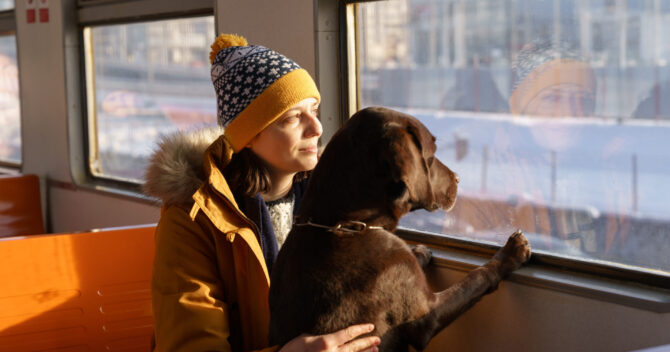
The next restriction concerns the behavior of the dog while traveling. It happens that dogs try to jump on the seats in the train during the train ride, but this is not allowed and they should not be allowed to do so. It's best to keep your pet entertained with a favorite toy or treat. When traveling with a dog by train, you should make sure that it is the least disruptive to other travelers and, if possible, only takes up space next to the owner's legs.
It is forbidden to stay in the catering cars
Dogs are also not allowed in the catering cars. In a situation where we want to travel more comfortably with our pet in a sleeping car or with places to lie down, we must buy all places in the compartment.
Dog on the train and order
The obligation to clean up after your pet before leaving the train is obvious, just like we do at home or on a walk.
Dog on the train - fees
Currently, all railway carriers allow you to travel with your dog by train. Small dogs can be transported by rail free of charge, provided that they travel in carriers, baskets, cages, etc. However, if we want our four-legged companions to be transported freely, we must purchase a ticket for them. For dogs kept on a leash on a train, a flat fee is usually paid, regardless of the length of the journey: the highest fee at PKP Intercity (approx. PLN 15), and between PLN 2 and PLN 5 on regional and SKM railways.
If a guide dog accompanies a blind or visually impaired person on a train journey, the statutory transport tariff provides a 95% discount when purchasing a ticket for it. It should be noted, however, that many railway carriers do not charge this fee for such working dogs.
It is best to buy a dog train ticket together with the purchase of your ticket, as it is assigned to the guardian's ticket. If you already have a ticket and later decide to take your dog with you by train, it will only be possible to buy a ticket for your pet at the ticket office of the station or from the conductor (electronic purchase is not possible). It should be remembered that the purchase of a dog ticket from the conductor is often associated with an additional fee.
Practical tips for traveling with your dog on the train
- Before traveling, pack the necessary documents and accessories to facilitate your dog's journey by train. You should take a valid dog ticket (if it is not transported in a carrier) and you must have a health book with a certificate of vaccination against rabies. When traveling with your pet in EU countries, you must have a European pet passport, which can be obtained from any authorized veterinarian. This passport must contain information about the rabies vaccination.
- In addition, in addition to the leash and muzzle, it is worth taking a small travel bowl and a bottle of water, as well as bags and paper to clean up any impurities. At the same time, you can take your pet's favorite toy (but not squeaking!) and odorless treats. A small mat or blanket will also be useful in case the dog does not like to lie on the floor.
- Before boarding the train, be sure to take your four-legged friend for a longer walk so that he relieves himself just before the journey. In addition, tired of the walk, he will probably fall asleep quickly and will not disturb his fellow passengers.
- When we are concerned that our pet may suffer from motion sickness, it is worth giving up the meal before the trip.
- Since the dog is quick to sense embarrassment or stress, it should be addressed in a normal, friendly tone when traveling by train.
Maybe you'll like it: